Crown Codex After AceBook: Backend and Access Checklist
Operators familiar with the AceBook gaming system may need to evaluate Crown Codex as its successor. Although the platforms may share some concepts, the change should not be treated as a simple rename or an automatic account migration. Operators should assign staff access carefully, test workflows, and prepare a structured transition plan.
Transitioning from AceBook to Crown Codex: Key Aspects
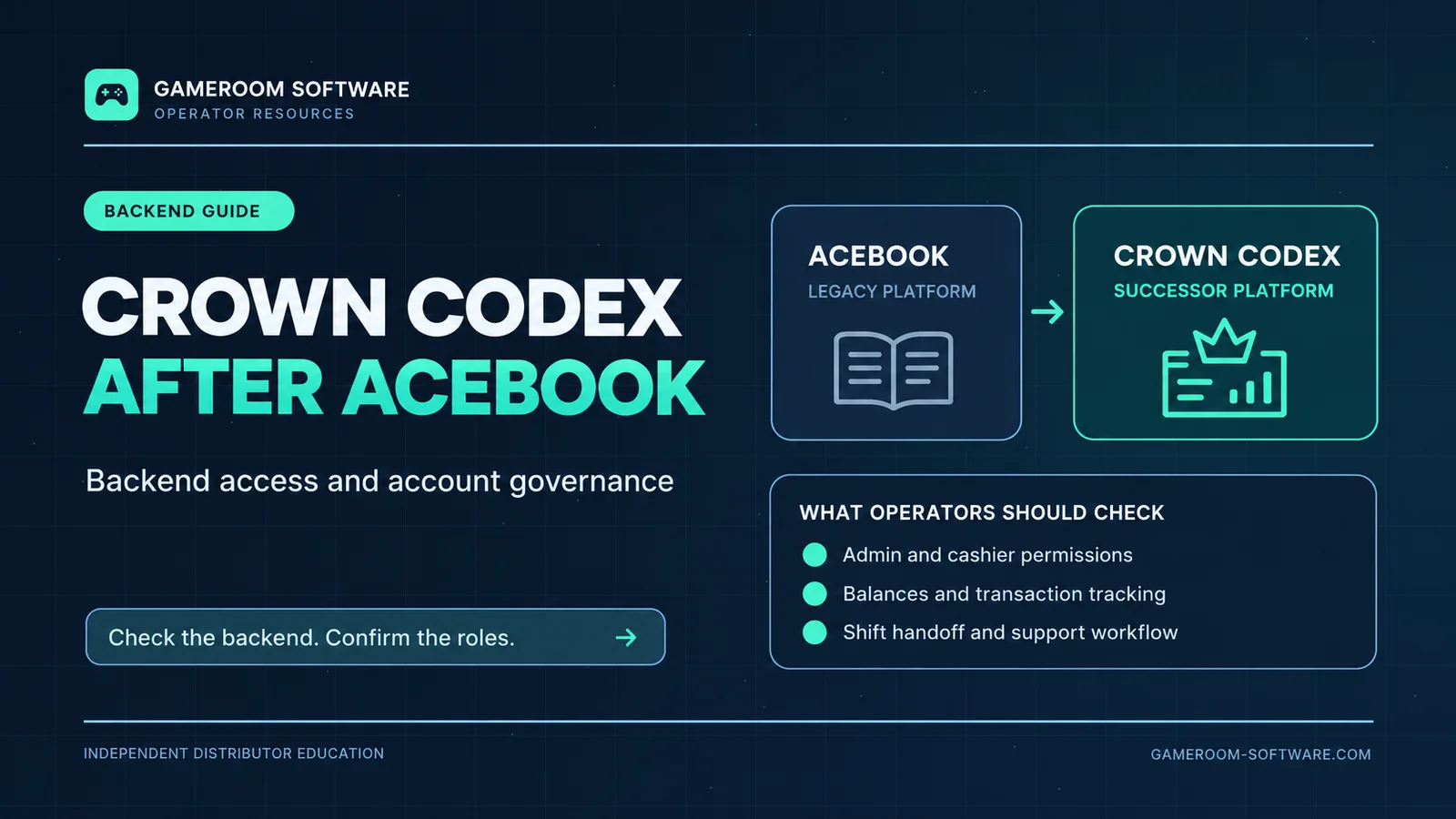
Crown Codex is presented as the successor to AceBook. Operators should understand the relationship between these systems without assuming that software, accounts, permissions, or credit balances are interchangeable. Confirm the applicable configuration with the supplier.
Before adopting Crown Codex, an operator must identify which components will remain unchanged during the transition and which will be altered. Key areas to examine include the user interface, daily task workflows, configuration nuances, transaction history, management complexity, credit balance handling, the structure of generated reports, and more. This approach will facilitate a better understanding of the new system and help prioritize tasks during the transition preparation phase.
Access Rights for Different Staff Members
Managing the Crown Codex gaming system requires assigning roles based on a defined hierarchy. In almost all cases, project participants will need access to the backend to perform specific tasks. There is no universal structure for this, as each configuration requires a unique approach. However, in most scenarios, different staff members may require the following types of access:
-
Administrator. Managing finances, organizational structure, certain game settings, reporting, and security parameters (e.g., account blocking).
-
Agent. Manage locations, oversee financial transactions, review statistical data, and manage personnel.
-
Location staff. Monitoring accounts, managing player profiles (creating profiles, linking loyalty cards, etc.), overseeing finances (tracking balances), and handling technical tasks (rebooting systems, submitting support requests, etc.).
-
Cashier. Handling financial transactions (e.g., topping up player balances, processing winnings payouts, etc.).
In certain situations, these staff members may require expanded access. However, additional permissions should not be granted indiscriminately. Instead, tasks requiring specific backend access should be handled by personnel authorized for those particular sections or functions. For further clarification on access distribution and security-related matters, the operator should consult with the provider.
What Should an Operator Check?
Transitioning to new gaming systems, such as Crown Codex, requires operators to complete several mandatory checks beforehand. Without them, the process could be delayed and lead to unpleasant surprises. All key aspects should be examined, with particular attention paid to the following areas:
-
Credits. Document credits remaining in AceBook separately and verify the purchasing process for the new system. Do not assume credit balances can be transferred.
-
Balances. Record legacy AceBook balances and the new Crown Codex balance independently. Confirm how each system displays and reconciles transactions.
-
Transactions. The presence of unique identifiers, processing speeds, the availability of detailed transaction information, and the procedures for canceling or repeating a transaction.
-
Reports. Alignment of dates and time zones, record completeness, calculation logic, data sorting capabilities, and the accuracy and reliability of the information presented.
Performing these checks before migrating to Crown Codex will let an operator verify that specific actions can be carried out, confirm whether essential features are present, ensure required reporting is available, and more. Gathering this information will also provide a deeper understanding of the new system and its full range of capabilities.
Pre-Shift Checklist for Daily Operations
The transition from AceBook to Crown Codex should conclude with a thorough verification of the new gaming system and all its associated components. This process must be completed before daily operations begin. Identifying potential issues or minor flaws in advance helps prevent equipment downtime and other operational delays. The standard procedure for verifying accounts and the Crown Codex backend before commencing daily operations is as follows:
-
Data compilation. Create lists of all personnel and assign specific roles and access levels for administrators, agents, retail staff, cashiers, and other project participants.
-
Access verification. Ensure that every staff member can log into their account and access the functions required for their specific duties.
-
Restriction testing. To verify operational security, staff should attempt to perform actions they are not authorized to carry out. This helps assess whether the system correctly responds to attempts to exceed established limitations.
-
Balance reconciliation. Record the balances for AceBook and Crown Codex separately; do not assume a shared balance or direct transfer between the platforms.
-
Test transactions. Perform trial operations, including topping up balances, deducting credits, and canceling or re-executing transactions.
-
Report reconciliation. Compare the data obtained during testing against the expected results.
-
Limited launch. Launch the Crown Codex gaming system on a limited scale to gather data on its performance under real-world conditions. The duration of this testing phase may vary, depending on the results obtained.
Each of these verification steps is essential. If any ambiguities or unresolved issues arise during the process, compile a list of questions for the provider. Once it is confirmed that there are no outstanding issues, you may proceed with daily operations using Crown Codex.
FAQ
Are Crown Codex and AceBook the same software?
Crown Codex and AceBook are distinct platforms, although they do share some common characteristics. They cannot be considered fully compatible or interchangeable. To learn about the key differences between these platforms, please request the relevant information from the provider.
Can unused AceBook credits be transferred to Crown Codex?
Do not assume a transfer is available. Plan to use existing AceBook credits on the original platform while it remains active, and establish a separate purchasing and accounting process for Crown Codex. Ask the provider to confirm the current account-specific terms.
What kind of access might an agent need?
Typically, an agent may require access to manage retail locations (for example, to open a new game room) and user accounts, as well as to oversee financial controls and various statistical data. This list is foundational and may vary depending on the requirements of a specific project.
Should the backend be checked before starting daily operations?
Yes, checking the backend before daily operations begin will help you evaluate how easy it is to manage the gaming system, detect errors, and identify accounting discrepancies.